
Walk through any hardware lab and you will see printed circuit boards in black, green, blue, yellow, purple, red and brown. Some manufacturers even offer white or pink boards. The variety can suggest that color signals quality, but the reality is simpler: the color comes from the solder mask, and it has no direct effect on electrical performance. What matters far more is how the exposed copper is protected before assembly. This article explains the role of solder mask, why black boards can complicate repair, and how gold and silver surface finishes protect pads without changing resistance or heat generation.
Why bare copper needs a protective layer
A printed circuit board has copper on both sides. Whether the copper is built up additively or etched subtractively, the result is a smooth, unprotected surface. Copper is less reactive than aluminum, iron or magnesium, but in the presence of water and oxygen, pure copper oxidizes quickly. Because the copper layer on a PCB is very thin, the resulting oxide is a poor electrical conductor and can seriously degrade the board's electrical performance.
To stop oxidation, separate the areas to be soldered from the rest of the board, and protect the surface, engineers apply a special coating. This coating forms a protective layer of controlled thickness and blocks contact between copper and air. The layer is called the solder mask, and the material is solder mask ink. Originally, solder mask could be made colorless and transparent. However, boards often need small printed text for manufacturing and repair, and a transparent mask only shows the base laminate, which is not ideal for inspection or identification. Engineers therefore add pigments to the solder mask, producing black, red, blue and other colored boards.
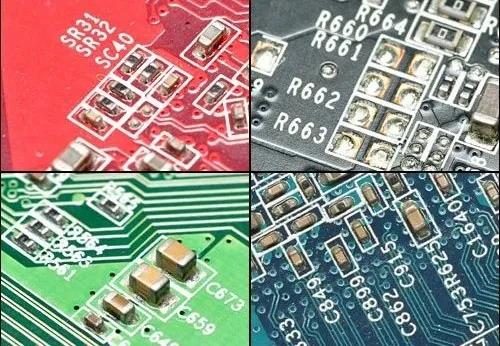
Does PCB color affect quality?
From a performance standpoint, PCB color and PCB quality are unrelated. A black board differs from a blue, yellow or green board only in the pigment in the solder mask. If the design and manufacturing process are identical, color has no effect on electrical performance and no effect on heat dissipation. The idea that color indicates high or low quality comes from product positioning, not physics: some manufacturers use black boards for premium products and red, blue, green or yellow boards for lower-tier products. The product gives the color meaning, not the other way around.
Black solder mask does have a practical drawback. Because it covers almost all top-layer traces, it makes later repair and rework much harder. For that reason, many teams have moved away from pure black toward dark green, dark brown and dark blue solder masks, which are easier to inspect and service.
Gold and silver surface finishes: what they actually do
Components must be soldered to the board, so part of the copper layer remains exposed. These exposed areas are the pads, usually rectangular or circular and quite small. After solder mask is applied, the pads are the copper still in contact with air. If pad copper oxidizes, soldering becomes difficult and resistivity rises sharply, which can hurt the final product. Engineers therefore protect pads in several ways: plating an inert metal such as gold, chemically depositing a silver layer, or applying a special chemical film such as OSP (organic solderability preservative) to block contact with air.
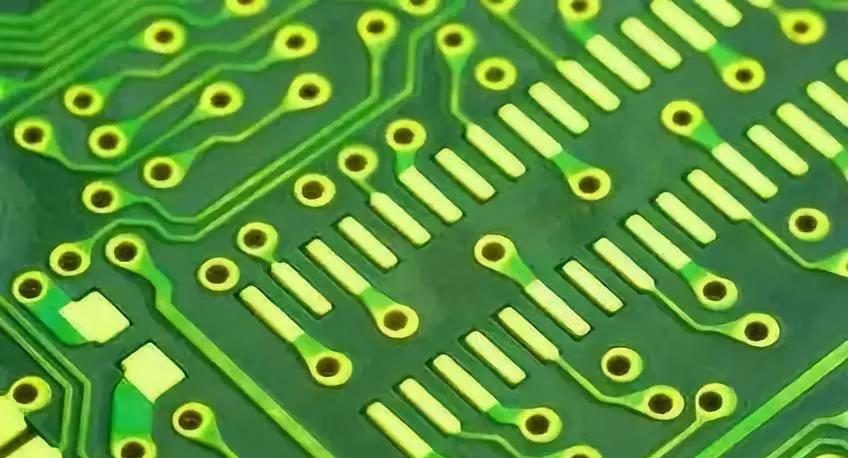
In every case, the purpose of the finish is the same: prevent oxidation and protect the pad so that the subsequent soldering process yields a high good-rate. The choice of metal does affect how long and under what conditions a PCB manufacturer can store the board before delivery. Many manufacturers vacuum-seal boards before shipping to limit oxidation damage. Before components are placed and reflow soldering begins, the assembly house may also check the degree of oxidation and screen out affected boards to protect yield. By the time a product reaches the end user, it has passed multiple inspections, and any oxidation that occurs during long-term use is typically limited to connector areas, with little effect on pads or soldered joints.
Do gold and silver reduce heat?
Because gold and silver have lower resistivity than copper, some assume that these finishes reduce heat during operation. That is not the case. Heat generation depends on resistance, and resistance depends on the conductor material, cross-sectional area and length. The metal layer on a pad is far thinner than 0.01 mm, and an OSP-treated pad adds essentially no extra thickness. At such thickness, the resistance contributed by the finish is effectively zero and cannot be meaningfully calculated, so it has no impact on heat generation.
The practical takeaway is that surface finish selection should be driven by solderability, storage life, pad geometry, inspection needs and the assembly process, not by assumptions about color or thermal performance. A dark board is not inherently better than a green one, and a gold finish is not a heat sink.
What this means for your build
- Treat solder mask color as a cosmetic and inspection choice. It does not change electrical performance or heat dissipation, so select it for contrast, repair visibility and AOI (automated optical inspection) compatibility.
- Choose the surface finish based on pad protection and solderability. ENIG (electroless nickel immersion gold), immersion silver, immersion tin, HASL and OSP (organic solderability preservative) each have different storage and process implications.
- Account for storage and handling. Finishes differ in how long and under what conditions boards can be stored; vacuum sealing and incoming oxidation checks help protect yield before reflow soldering.
- Avoid black solder mask on boards that may need rework, because it hides traces and makes repair harder. Dark green, dark brown and dark blue are easier to service.
- Do not expect a precious-metal finish to reduce operating temperature. The finish thickness is negligible, so thermal design must come from copper geometry, stackup and current path.
Source: compiled from public web sources.