
When an 850 nm vertical-cavity surface-emitting laser (VCSEL) is pushed from 6 mA to 12 mA bias, its -3 dB bandwidth inches up from 24.0 GHz to 27.3 GHz. Doubling the current buys only 3.3 GHz, and the energy cost per gigahertz jumps from 0.77 mW to 8 mW. The bottleneck is not the relaxation oscillation frequency—it is damping. A 100G single-lane link needs 37 GHz, leaving a 10 GHz gap.
The short answer: relaxation oscillation frequency rises with the square root of bias current, while damping rises with the square of that frequency. The two curves cross near 27 GHz. Beyond that point, adding bias only increases damping and junction temperature; the -3 dB bandwidth no longer follows.
Two upper limits on bandwidth
A VCSEL emits light perpendicular to the substrate, with two distributed Bragg reflector stacks sandwiching the active region. Its modulation bandwidth is set by whichever of two limits is lower.
The first is the relaxation oscillation frequency—the resonant exchange of energy between photons and carriers in the cavity:
fR = D × √(I − Ith)
Here D is the slope coefficient in GHz per √mA, I is the bias current, and Ith is the threshold current. This term rises monotonically with bias, so at first glance more current means more bandwidth.
The second limit is damping. As bias increases, photon density in the cavity rises, and stimulated recombination suppresses perturbations faster, flattening the resonance peak. Damping grows with the square of fR, much faster than fR itself.
Relaxation oscillation follows a square root
Consider published parameters for an 850 nm oxide-confined VCSEL: threshold current 0.9 mA, slope coefficient 8.2 GHz/√mA, slope efficiency 0.9 mW/mA, operating voltage 2.2 V.
At 2 mA bias, fR is 8.6 GHz; at 6 mA, 18.5 GHz; at 12 mA, 27.2 GHz. Six times the current yields just over three times the frequency—consistent with a square root.
Measured -3 dB bandwidth exceeds fR at low bias because the resonance peak lifts the response: at 2 mA it is 12.5 GHz (850 nm, 4 µm aperture, 25°C), or 1.45× fR.
As of November 2026, commercial 850 nm multimode VCSELs typically show -3 dB bandwidths of 25 to 30 GHz. Laboratory short-cavity and Zn-diffused structures can exceed 33 GHz, but yield has not caught up.
Damping pins the ceiling at 27 GHz
At 6 mA bias, the -3 dB bandwidth is 24.0 GHz—already 1.3× fR. At 8 mA, 26.2 GHz; at 10 mA, 27.0 GHz; at 12 mA, 27.3 GHz, only 0.1 GHz above fR. The resonance peak is essentially gone.
The marginal cost turns sharply here. From 2 mA to 6 mA, electrical power rises from 4.4 mW to 13.2 mW and bandwidth gains 11.5 GHz—0.77 mW per GHz. From 8 mA to 12 mA, the same 8.8 mW power increase yields only 1.1 GHz, or 8 mW per GHz—ten times worse.
100G per lane is 10 GHz short
A 100G single-lane link using PAM4 at 53 GBd has a Nyquist frequency of 26.5 GHz. With a 0.7 roll-off factor, it needs 37 GHz of bandwidth.
In rise-time terms, 27.3 GHz gives 12.8 ps; 37 GHz gives 9.5 ps. The unit interval at 53 GBd is 18.9 ps, so the ratios are 0.68 and 0.50. A ratio of 0.68 means the eye diagram is already blurred around the sampling point; equalization can recover some of it, at the cost of receiver power and latency.
Equalization power scales with taps. At 53 GBd, each feed-forward tap costs about 0.24 W per channel; five taps mean 1.2 W. Each decision-feedback tap costs 0.15 W; two taps mean 0.3 W. Across four channels, equalization consumes 6 W—two orders of magnitude more than the entire VCSEL's 26.4 mW.
Failure case: a 20°C rise, three orders of magnitude in BER
A four-channel short-reach module running at 25°C shows a bit error rate of 1×10⁻⁸. When the ambient rises to 45°C, BER climbs to 1×10⁻⁵, and only dropping to 50G restores operation.
The cause is not bandwidth but threshold current and slope efficiency. A 20 K rise pushes threshold current from 0.9 mA to 1.25 mA and drops slope efficiency from 0.9 to 0.79 mW/mA. At a constant 8 mA bias, output power falls from 6.39 mW to 5.33 mW, modulation swing shrinks proportionally, and extinction ratio drops from 4.5 dB to 3.7 dB.
The fix is to switch the driver to automatic power control (APC), using a monitor photodiode to lock average optical power and letting bias current track threshold—at 45°C it automatically rises to 8.35 mA. The cost: the monitor diode taps about 5% of the light, cutting link budget by 0.2 dB, and the APC loop must respond within 1 ms or the header of burst packets will be clipped.
How earlier generations coped
The same device spanned two previous speed generations. 25G NRZ at 12.5 GBd needs 8.9 GHz with 0.7 roll-off—27.3 GHz leaves ample margin.
50G PAM4 at 26.5 GBd needs 18.9 GHz, still leaving 8.4 GHz margin. 100G PAM4 at 53 GBd needs 37 GHz, turning the margin into -9.7 GHz.
The margin flipping from positive to negative is why this generation of VCSEL links must use equalization.
There is also self-heating. At 12 mA bias and 2.2 V, the device dissipates 26.4 mW. With a thermal resistance of 1.2 K/mW in the active region, junction temperature runs 32 K above case temperature. Threshold current rises by 0.5 mA, and measured bandwidth is 0.8 GHz lower than cold—erasing the small gain from the extra bias.
Another path is to separate the modulator. The VCSEL runs continuous-wave only, and modulation is handled by an integrated electro-absorption modulator whose bandwidth depends on capacitance and electrode length, not carrier lifetime. The cost is 3 to 4 dB of extra insertion loss, requiring higher laser power.
Analysis: extra bias trades power for damping
A default move in driver design is to raise bias current when bandwidth falls short. By the numbers above, that move exhausts its benefit at 6 mA; beyond that, each gigahertz costs 8 mW and pushes junction temperature higher.
The real lever is reducing the damping coefficient—shrinking the active volume, for example by reducing the oxide aperture from 4 µm to 3 µm. A smaller volume means higher carrier density at the same injection current, so fR rises faster and the absolute damping drops. The trade-offs are higher series resistance, lower single-mode output power, and current density approaching reliability limits.
This judgment can be falsified: if shrinking the oxide aperture from 4 µm to 3 µm yields less than 15% bandwidth improvement, then the limit is pad capacitance and lead inductance, not damping—and the package, not the epitaxy, is what needs changing.
The same accounting explains why 200G per lane does not use directly modulated VCSELs. At 106 GBd, it would need 74 GHz, which no damping optimization can reach.
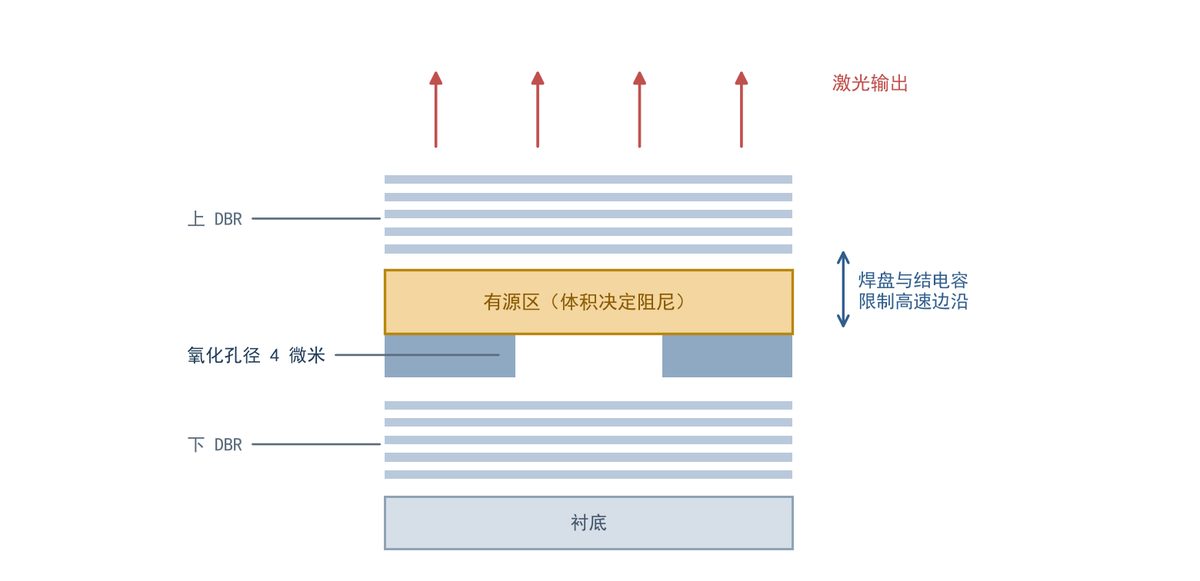
Figure 1: VCSEL layer stack and active volume; oxide aperture and pad capacitance jointly limit high-speed edges (original schematic, not a reproduction of source figures).
Bias current vs. bandwidth trade-off table
| Bias current (850 nm, 4 µm aperture) | Relaxation oscillation frequency | Measured -3 dB bandwidth | Output optical power | Electrical power | Marginal power per GHz | Verdict |
|---|---|---|---|---|---|---|
| 2 mA | 8.6 GHz | 12.5 GHz | 0.99 mW | 4.4 mW | Reference | Only enough for 25G NRZ |
| 4 mA | 14.4 GHz | 19.5 GHz | 2.79 mW | 8.8 mW | 0.60 mW | Marginal for 50G PAM4 |
| 6 mA | 18.5 GHz | 24.0 GHz | 4.59 mW | 13.2 mW | 0.77 mW | Inflection point |
| 8 mA | 21.8 GHz | 26.2 GHz | 6.39 mW | 17.6 mW | 2.0 mW | Low-efficiency region |
| 12 mA | 27.2 GHz | 27.3 GHz | 9.99 mW | 26.4 mW | 8.0 mW | Ceiling; further bias useless |
Table notes: threshold current 0.9 mA, slope coefficient 8.2 GHz/√mA, slope efficiency 0.9 mW/mA, operating voltage 2.2 V. Marginal power is the difference in electrical power between adjacent rows divided by the difference in bandwidth. Bandwidth requirements assume 0.7 roll-off: 25G NRZ needs 8.9 GHz, 50G PAM4 needs 18.9 GHz, 100G PAM4 needs 37 GHz.
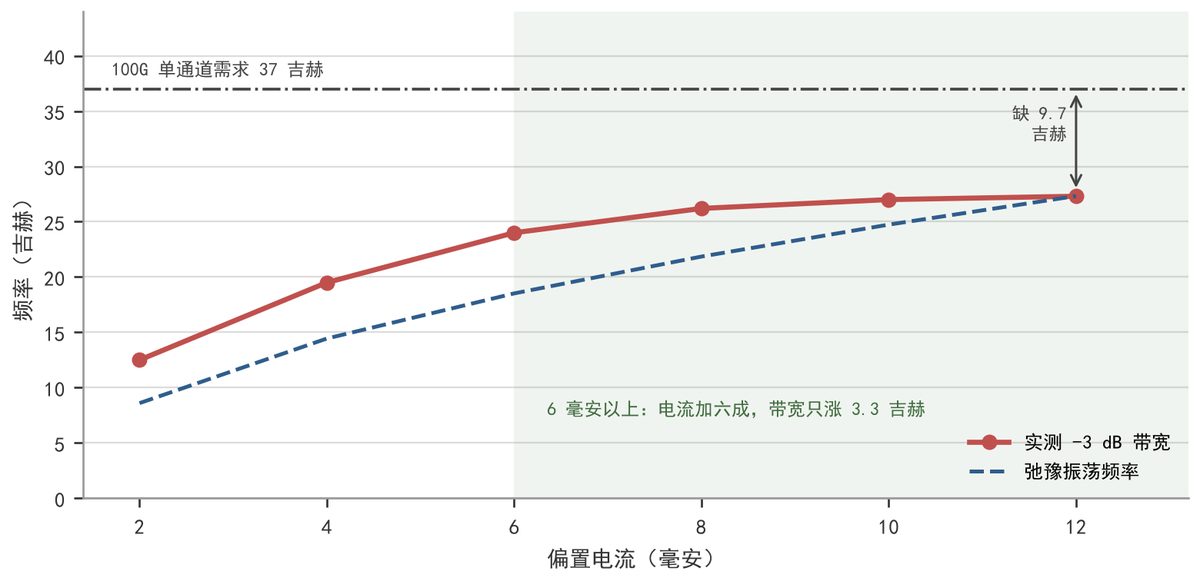
Figure 2: Measured bandwidth and relaxation oscillation frequency vs. bias current. The dash-dot line marks the 37 GHz requirement for 100G per lane; the shaded region on the right shows diminishing returns (original plot, redrawn from published parameters using rate equations, not a reproduction of source figures).
A selection walk-through under constraints
Consider a four-channel 100G link over 100 m of OM4 multimode fiber, 53 GBd PAM4 per lane, module power under 3.5 W per end, case temperature 70°C, and BOM under $40 per end.
Three candidates. A: 850 nm, 4 µm aperture VCSEL, 27.3 GHz bandwidth, requiring 5-tap feed-forward plus 2-tap decision-feedback equalization, 1.5 W per channel. B: 940 nm short-cavity VCSEL, 33 GHz bandwidth, requiring 2-tap feed-forward plus 1-tap decision-feedback, 0.63 W per channel. C: 1060 nm single-mode VCSEL, 40 GHz bandwidth, no equalization needed, but requires single-mode fiber and pushes BOM to $70.
Comparing item by item: A's four-channel DSP power of 6 W far exceeds the 3.5 W module budget—out. C has the widest bandwidth but single-mode fiber raises both cost and installation requirements for 100 m, and BOM is over limit. B's 33 GHz with 2-tap equalization draws 2.5 W across four channels, leaving 1 W for driver and monitoring.
Choose B. Two costs: 940 nm attenuation in OM4 is about 1.8 dB/km higher than 850 nm, adding 0.18 dB over 100 m and narrowing link margin; and 940 nm is more temperature-sensitive, with a wavelength drift of about 0.07 nm/K, so the receiver filter must be widened by 2 nm.
If-then rule: if link budget margin is below 2 dB and reach is only 50 m, stay at 850 nm with 5-tap equalization, accepting 1.2 W per channel DSP power; if reach exceeds 100 m and power budget is tight, switch to the 940 nm short-cavity device, accepting coupling tolerance tightened to 1.5 µm.
In one sentence: VCSEL bandwidth is capped by damping, not bias—beyond 6 mA, every gigahertz must be bought with milliwatts.
References: the open-access literature below provided the mechanism and parameters; tables, calculations, cases, and figures in this article are original. F. Hsiao, Y. Lin, C. Tsai, C. Li, “High-Bandwidth 940 nm VCSEL with Zn-Diffusion for Optical Communications,” Photonics, 2026, 13(4):353, DOI 10.3390/photonics13040353 (CC BY 4.0). Second source: K. Panajotov, R. Schatz, “Coupled-Cavity VCSEL with an Integrated Electro-Absorption Modulator: Small- and Large-Signal Modulation Analysis,” Applied Sciences, 2020, 10(17):6128, DOI 10.3390/app10176128 (CC BY 4.0). Figures are original schematics or redrawn from published data, not reproductions; Figure 2 data points are fitted to fR = D√(I−Ith) and measured bandwidth curves.
What this means for your build
- Do not treat bias current as a bandwidth knob. Beyond roughly 6 mA, each additional gigahertz costs about 8 mW and raises junction temperature, often erasing the gain.
- For 100G per lane, budget for equalization from the start. A 27 GHz VCSEL needs about 5 feed-forward and 2 decision-feedback taps, which can consume several watts across channels.
- Specify automatic power control (APC) in the driver to track threshold current over temperature; otherwise a 20°C rise can degrade BER by three orders of magnitude.
- When evaluating a faster VCSEL, test whether shrinking the oxide aperture improves bandwidth by more than 15%. If not, the package parasitics—not the epitaxy—are the limit.
- For 200G per lane, plan on an external modulator or a different laser technology; directly modulated VCSELs cannot reach the required 74 GHz.
Source: compiled from public web sources.