
Display power in AI glasses does not scale linearly with brightness. MicroLED external quantum efficiency (EQE) peaks at a current density between 1 A/cm² and 3 A/cm², then falls into droop. Push the panel from 500 nit to 1000 nit at the eye and electrical power rises by roughly 2.5×, cutting battery life by the same factor.
The short answer: an optical waveguide delivers only about 1% of the panel's light to the eye, so the panel must emit around 100,000 nit to put 1000 nit in front of the wearer. That leverage is where the runtime goes.
Waveguide efficiency sets the starting point
An optical waveguide uses total internal reflection to carry the microdisplay image to a transparent plate in front of the eye. Diffraction gratings handle in-coupling, pupil expansion and out-coupling. Multiply the three stages and the result lands near 1%: 30% at the in-coupling grating, 80% at each of two pupil expansions, and 15% at the out-coupling grating, for a cumulative 0.9%.
To get 1000 nit to the eye, the panel has to produce roughly 100,000 nit. Waveguide efficiency has improved slowly. Single-layer surface-relief gratings typically sit between 0.5% and 1.5%, two-layer gratings reach about 2%, and polarization volume holographic approaches have reported 4% in the lab but are not in volume production.
As of October 2026, monocular displays in AI glasses are commonly specified at 1000 nit at the eye, while measured outdoor performance at noon is only 300 to 500 nit. The gap comes from panels that cannot reach 100,000 nit. That 100× lever is the origin of every power problem downstream. For a 0.3 cm² display area, 100,000 nit corresponds to 9.4 lm of luminous flux; at a luminous efficacy of 500 lm/W for green light, that is 18.8 mW of radiant power.
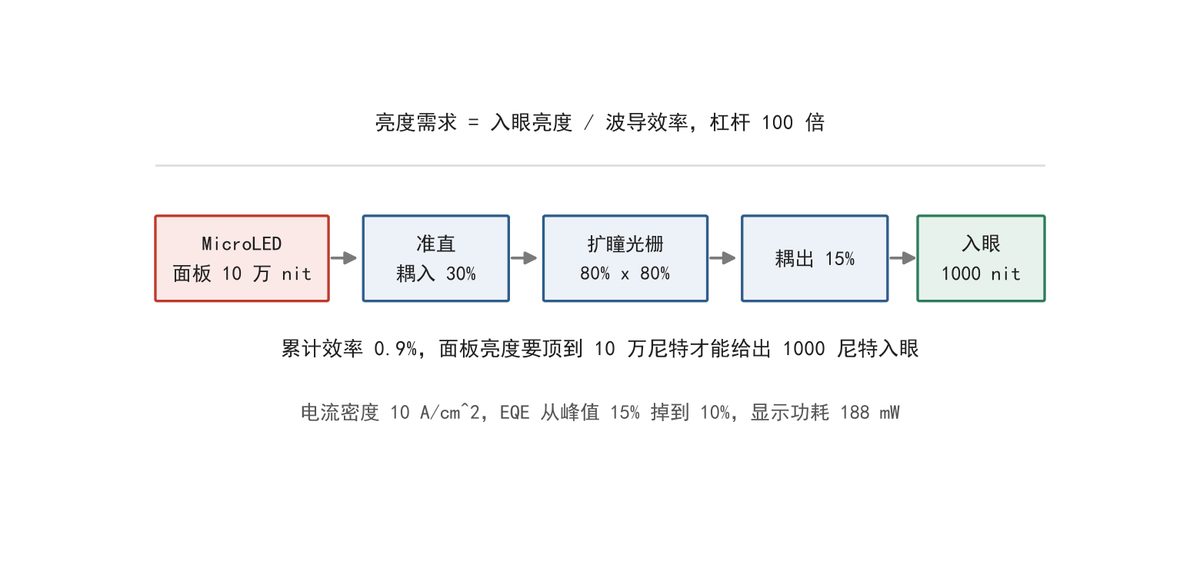
Figure 1: Efficiency budget from MicroLED to the eye (original schematic, not a reproduction of source artwork).
EQE falls as current density climbs
MicroLED EQE is not a constant. It rises with current density, peaks between 1 A/cm² and 3 A/cm², and then enters the droop region. Published research attributes droop mainly to injection current efficiency: carriers overflow from the active region into the p-layer and recombine as heat instead of light. Green devices overflow more than blue, so their droop is steeper.
Size effects stack on top of droop. Shrinking a pixel from 20 µm to 5 µm raises the sidewall area-to-volume ratio by 4×, and non-radiative recombination at the sidewalls pulls peak EQE from 25% down to 15%. Absolute brightness at the same current density is lower. This is why glasses must use small pixels and must accept lower efficiency.
A practical fit describes the curve: EQE(J) = EQE_peak / (1 + J / J₀), with EQE_peak at 15% and J₀ at 20 A/cm². At 10 A/cm² the EQE is 10%; at 20 A/cm² it is 7.5%.
From 500 to 1000 nit, power rises 2.5×
Panel brightness is proportional to current density times EQE. Combining the two relationships, 100,000 nit corresponds to J = 10 A/cm² and 50,000 nit to J = 4 A/cm².
Using published parameters: as J rises from 4 to 10 A/cm², brightness doubles, EQE falls from 12.5% to 10%, and electrical power rises from 75 mW to 188 mW, a ratio of 2.5. Doubling brightness costs 1.5× extra power, and that loss cannot be recovered in the driver circuit.
The driver has its own budget. MicroLED forward voltage is 2.6 V to 2.9 V. Driving directly from a 3.8 V battery through a linear constant-current sink wastes roughly 25% in the voltage drop. A buck-boost constant-current driver can reach 90% efficiency, at the cost of inductor volume and EMI.
Runtime follows the same curve. A 300 mAh battery at 3.8 V holds 1.14 Wh; if the display takes 60%, that is 0.68 Wh. At 500 nit the display runs 9.1 hours, at 1000 nit 3.6 hours, and at 1500 nit only 1.8 hours. The same battery delivers a 5× runtime difference depending on the brightness setting, which is the first specification worth asking about.
The curve steepens further up. At J = 20 A/cm², brightness is 150,000 nit and power is 376 mW, 5× the 500 nit setting for only 3× the brightness.
| Eye brightness (nit) | Panel brightness (kd/m²) | Current density (A/cm²) | EQE (%) | Display power (mW) | Runtime (h, 300 mAh) | Verdict |
| 200 | 20 | 1.4 | 14.0 | 27 | 25 | Unusable outdoors |
| 500 | 50 | 4.0 | 12.5 | 75 | 9.1 | Usable indoors |
| 800 | 80 | 7.3 | 11.0 | 137 | 5.0 | Mainstream setting |
| 1000 | 100 | 10.0 | 10.0 | 188 | 3.6 | Outdoor minimum |
| 1500 | 150 | 20.0 | 7.5 | 376 | 1.8 | Runtime unacceptable |
Table notes: brightness converted at 0.9% waveguide efficiency, 0.3 cm² display area and 500 lm/W green efficacy; EQE fitted as 15%/(1+J/20); runtime based on 300 mAh, 3.8 V, display at 60% of system power, excluding SoC and wireless.
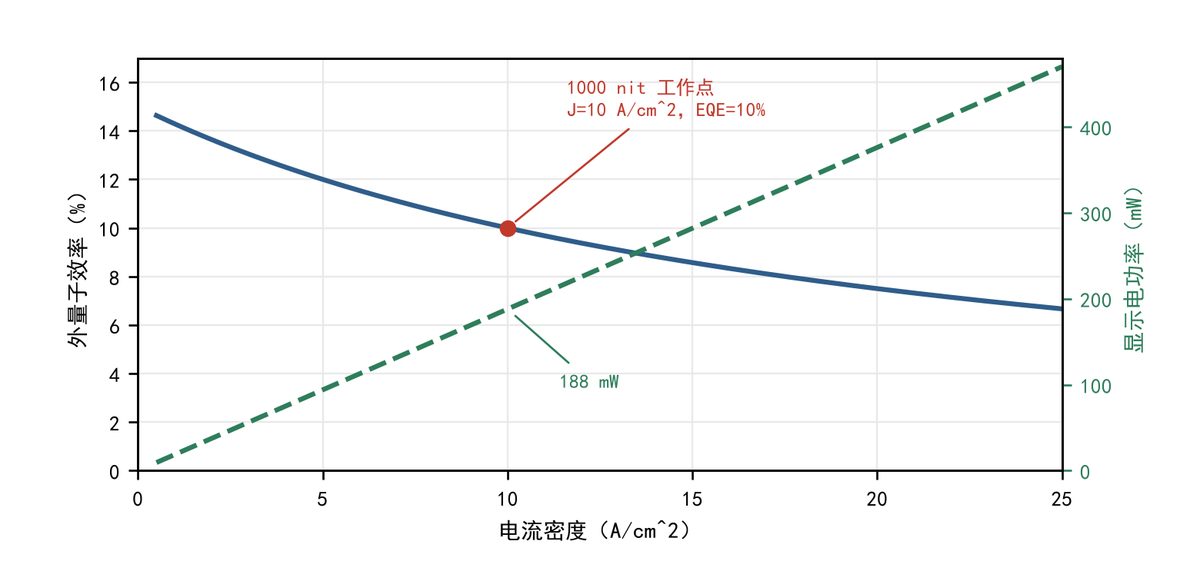
Figure 2: Current density versus EQE and display power (original chart redrawn from published parameters, not a reproduction of source artwork).
Green droops faster than blue
In the same structure, green MicroLEDs droop noticeably faster than blue. The polarization field in the green InGaN active region is stronger, reducing electron-hole wavefunction overlap and raising the overflow current fraction. Reaching 530 nm requires more indium in the active region, which increases lattice-mismatch defect density and non-radiative recombination centers. Blue structures overflow less because their electron-blocking layers work better and hole injection is more efficient.
That difference matters for glasses. Monolithic full-color approaches rely on green as the brightness workhorse: the eye is most sensitive near 555 nm, and green contributes about 70% of perceived brightness, yet it has the fastest efficiency roll-off. As of October 2026, published green MicroLED EQE at 10 A/cm² falls between 8% and 12%, while blue at the same condition sits between 12% and 16%. A value of 10% is reasonable for power budgeting, and the calculations here use it; measured results are typically one to two points lower.
Dimming by current does not save power
The common claim that lowering brightness saves power holds only in a narrow range for MicroLED. The EQE curve is hump-shaped, so reducing current pushes the operating point left of the peak and efficiency falls too. Dropping the drive current for 1000 nit to 40% puts J at 4 A/cm² and brightness at 500 nit; power does fall to 75 mW, but going lower shifts the peak wavelength and color coordinates, and the image degrades first. The correct dimming method keeps current density near the EQE peak and varies duty cycle with pulse-width modulation.
At the same 500 nit average brightness, a 50% duty cycle gives an instantaneous J of 8 A/cm², an EQE of 10.7%, and an average power of 82 mW. That is slightly above the 75 mW of current-amplitude dimming, but color coordinates stay stable and the driver runs at fixed current with better linearity.
Failure shows up most clearly at low brightness settings: flicker and color shift at a 200 nit night mode, visible to the eye. The driver has pushed current down to 1.4 A/cm², placing the operating point on the left rising slope of the EQE curve, so 1% current ripple becomes 3% brightness ripple. The fix is fixed-current duty-cycle dimming, moving the operating point back above 8 A/cm² so ripple scales linearly with duty cycle.
The cost is measurable. At the same 500 nit, current dimming uses 75 mW and duty-cycle dimming uses 82 mW, 7 mW more, or 2.8% of a 250 mW system. Trading 2.8% for stable color coordinates and linearity is worthwhile in glasses. The boundary is also clear: below 10% duty cycle the driver must supply 10× peak current, and switching losses and peak-current stress dominate; below 5% duty cycle it is not worthwhile for MicroLED.
Selection walk-through: a 300 mAh pair of glasses
Apply these constraints: monocular display, 1000 nit peak at the eye, 500 nit typical use, 300 mAh battery, 250 mW system power budget, 8 mm temple thickness limit, and a $1.20 display driver budget.
Three candidates: a 5 µm single MicroLED with a 0.9% waveguide, a 3 µm single emitter with the same waveguide, and a 5 µm emitter with a 2% two-layer grating waveguide.
The 5 µm device with the 0.9% waveguide is the baseline: 188 mW at 1000 nit, 313 mW system, over the 250 mW budget. The 3 µm emitter has a smaller area and insufficient total flux at the same current density; pushing to 15 A/cm² drops EQE to 8.3% and raises power to 452 mW. The two-layer grating lifts waveguide efficiency to 2%, cutting the panel brightness requirement from 100,000 nit to 50,000 nit, so J falls to 4 A/cm² and power to 75 mW.
Only the third option fits the budget, and it does so not through a brighter LED but through a more efficient optical path. That matters far more in glasses than in televisions, because battery energy density improves only about 5% per year while waveguide efficiency can still double.
The selected design is the 5 µm emitter with the two-layer grating waveguide. Raising waveguide efficiency from 0.9% to 2% cuts the burden on the whole chain by more than half: at 1000 nit, power is 188 × (0.9/2) = 85 mW, system power is 210 mW, inside the 250 mW budget, and runtime at 500 nit typical use is about 9 hours.
A second benefit is that droop stops being a variable once current density comes down. At J = 4 A/cm² the operating point sits near the EQE peak, brightness is adjusted by duty cycle, and color coordinates do not drift with brightness. For a small several-hundred-nit image in glasses, that matters more than saving a few milliwatts.
The $1.20 display driver budget is unaffected; the overrun is in the module budget, where the waveguide cost difference moves upward.
Waveguide suppliers quote nominal efficiency, and batch consistency is about ±0.2 percentage points. Translated to 100,000 nit brightness and 188 mW power, that is a half-hour runtime difference.
Trade-offs and risks: higher out-coupling efficiency in a two-layer grating produces stronger rainbow artifacts and ambient-light diffraction, graying the image in outdoor sun; the second layer adds a nanoimprint step and raises waveguide cost by 35%, from $6 to $8.10 per piece; grating period is more wavelength-sensitive, and green-band yield runs 4 points below single-layer.
If the eye-brightness requirement exceeds 800 nit and the battery is under 350 mAh, raise waveguide efficiency above 2% before discussing MicroLED current density, at the cost of roughly 30% higher waveguide cost and stronger rainbow artifacts.
What this means for your build
- Budget waveguide efficiency first. The 100× panel-to-eye leverage dominates every other loss. Moving from 0.9% to 2% waveguide efficiency halves the current density needed and can bring a 1000 nit design inside a 250 mW budget.
- Keep the operating point near the EQE peak. Design for J around 4 A/cm² where droop is mild; pushing past 10 A/cm² costs 2.5× power for 2× brightness, and past 20 A/cm² the penalty grows to 5×.
- Dim with duty cycle, not current amplitude. Fixed-current PWM keeps color coordinates stable and linearity good; the 2.8% power premium at 500 nit is a fair trade. Avoid duty cycles below 10%.
- Use conservative EQE for green. Green MicroLEDs at 10 A/cm² sit at 8% to 12% EQE in published work; budget at 10% and verify against measured parts, since production typically runs one to two points lower.
- Account for waveguide tolerance. A ±0.2 percentage-point batch spread translates to roughly half an hour of runtime at the 1000 nit setting, so specify and test waveguide efficiency as a controlled parameter.
Source: compiled from public web sources.